
If you still owe money on your mortgage, selling a house with a mortgage is still completely normal, it’s how most UK property sales happen. The balance gets paid off automatically at completion, directly from the sale proceeds, before you see a penny of the rest.
Table of Contents
What trips people up isn’t whether you’re allowed to sell, you are, it’s not knowing what actually happens to the loan, what it might cost to settle early, and what happens if the sale price doesn’t clear the balance. This guide covers each of those in order, then looks at how it works specifically when you’re selling through auction rather than a traditional chain.
Can You Sell a House With a Mortgage Still Owing?
Yes. Having an outstanding mortgage is not a barrier to selling, it’s the normal situation for the vast majority of UK home sellers. Your mortgage is secured against the property as a legal charge, and that charge simply gets removed and the debt repaid as part of the sale completing.
The only real requirement is that the sale proceeds (or your own additional funds) are enough to clear what you owe, including any early repayment charge that applies. If they aren’t, you’re in negative equity, covered further down.
How Your Mortgage Gets Paid Off at Completion
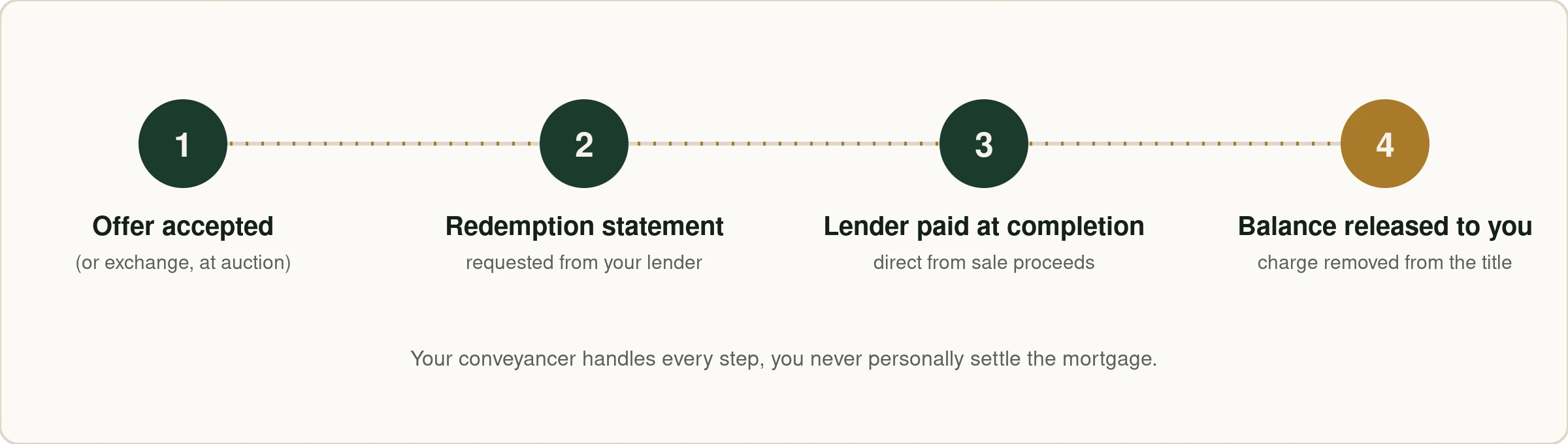
Once you’ve accepted an offer (or, with an auction sale, once contracts have exchanged), your conveyancer requests a redemption statement from your lender. This is a figure valid for a specific date, showing exactly what’s needed to clear the mortgage in full, including any interest accrued and applicable charges.
On completion day, your conveyancer pays that redemption figure to your lender directly from the buyer’s funds, before transferring whatever remains to you. You never personally handle the mortgage settlement, it happens as part of the legal completion process.
Removing the Mortgage From the Title
Once your lender has received the redemption payment, they remove their charge from the property’s title at HM Land Registry. This is usually done electronically through what’s called an e-DS1 discharge, the digital version of the DS1 form lenders use to confirm a registered mortgage has been repaid and can be cancelled from the register.
Most lenders handle this automatically within a few weeks of completion, and it’s not something you or your conveyancer need to chase in a normal sale. It simply confirms, on the public record, that the property is no longer charged to that lender.
Early Repayment Charges, Explained
If you’re still inside a fixed, tracker or discounted deal, your lender may apply an early repayment charge (ERC) for settling the mortgage before the deal ends. The FCA defines an ERC as a charge a lender can levy when a loan is repaid in full or in part before a date or event set out in the mortgage contract.
The FCA’s rules require that charge to be expressed as a clear cash amount and to be a reasonable reflection of the lender’s actual costs, not an arbitrary penalty. Your redemption statement will show the exact figure, so there’s no guesswork involved by the time you reach completion, but it’s worth checking your mortgage offer or asking your lender directly before you commit to a sale date, so it doesn’t come as a surprise.
What If You Owe More Than the House Is Worth?
Negative equity means the mortgage balance is higher than what the property will realistically sell for. It’s most common after a fall in local property prices or where a high loan-to-value mortgage was taken out shortly before values dropped.
If the sale proceeds won’t clear the mortgage in full, you’ll need to cover the shortfall from your own savings, or speak to your lender about options before marketing the property, most lenders won’t let completion proceed with the charge only partly cleared. It’s a conversation worth having early, not something to discover at redemption-statement stage.
Porting Your Mortgage to a New Property
If you’re selling to buy somewhere else, some lenders let you “port” your existing mortgage, keeping your current rate and terms and moving them to the new property, rather than redeeming the loan and starting fresh. It still isn’t automatic.
- You’ll go through a fresh affordability check and a new valuation on the property you’re buying.
- The sale and purchase need to complete close enough together that the porting window doesn’t lapse, lenders set their own limits on this.
- If the new property costs more, you’ll typically need a separate additional loan alongside the ported amount, often at a different rate.
Confirm porting eligibility with your lender as early as possible if it matters to your plans, it affects how tightly your sale and onward purchase need to be timed.
Selling at Auction With a Mortgage Still in Place
The mortgage mechanics don’t change when you sell through auction instead of a traditional estate agent, your conveyancer still redeems the balance from the proceeds at completion, in exactly the same way. What changes is the timeline.
At auction, exchange of contracts happens on the fall of the hammer (or on acceptance, with the Modern Method of Auction), and completion follows on a fixed, usually much shorter schedule than a typical chain-based sale. That means your redemption statement needs requesting earlier, so there’s no delay between exchange and the figure your lender needs on completion day.
This is also where auction genuinely helps anyone juggling a mortgage redemption against a tight personal timeline, divorce, relocation, or wanting certainty before committing to a new purchase. A fixed completion date means you know exactly when the mortgage clears, rather than it moving with a buyer’s chain.
A Worked Example
This is an illustrative example only, to show how the numbers interact, not a quote or a forecast for any real sale.
- Outstanding mortgage balance at completion: £140,000
- Early repayment charge (2% of balance, inside a fixed deal): £2,800
- Sale price achieved: £235,000
- Less mortgage redemption and ERC: £142,800
- Less legal and auction fees (illustrative): £3,500
- Proceeds to the seller: £88,700
The redemption statement would show £142,800 as the figure due to the lender, paid directly from the sale proceeds at completion, before the remaining balance reaches the seller.
Mortgage Objections, Answered
“I’m worried my lender will refuse to let me sell.” They won’t, provided the mortgage can be redeemed (or the shortfall covered) at completion. Lenders deal with this every day, it’s a routine part of conveyancing, not a special request.
“I don’t know what my early repayment charge will be.” Your lender can usually give you an estimated figure on request, before you’ve committed to a sale date, so you can factor it into your numbers rather than finding out at the last moment.
“I’m scared the sale won’t cover what I owe.” Get a realistic valuation first, a free valuation gives you a genuine figure to compare against your redemption amount, before you commit to marketing the property at all.
Frequently asked questions
Can I sell my house if I still owe money on the mortgage?
Yes. Most UK home sales happen with a mortgage still outstanding. Your conveyancer requests a redemption statement from your lender, pays off the balance from the sale proceeds at completion, and you receive whatever is left.
How is my mortgage actually paid off when I sell?
Your conveyancer gets a redemption statement showing the exact amount owed on your intended completion date, then sends that amount to your lender directly from the sale proceeds before releasing the balance to you.
What is an early repayment charge?
An early repayment charge (ERC) is a fee some lenders apply when you pay off a mortgage, in full or in part, before a fixed or discounted deal ends. The FCA requires it to be stated as a cash amount and to be a reasonable reflection of the lender’s costs, not an arbitrary penalty.
What happens if I’m in negative equity?
You’ll need to cover the shortfall between the sale price and what’s left on the mortgage from your own funds, or agree a plan with your lender before completion. Most lenders won’t allow completion to proceed without the shortfall being covered one way or another.
Can I take my mortgage with me to a new property?
Some lenders allow porting, moving your existing rate and terms to a new property rather than starting a fresh deal. It still requires a new affordability and valuation check, and timing between the sale and purchase has to line up, so confirm with your lender early rather than assuming it’s automatic.
Does selling at auction change how my mortgage is settled?
No, the mechanics are the same, your conveyancer still redeems the mortgage from the proceeds at completion. What auction changes is the timeline: exchange and completion happen on a fixed, much shorter schedule than a traditional sale, so your redemption figure needs requesting earlier.
If you’re weighing up how a mortgage redemption fits around your own sale timeline, a free valuation is the right next step, it gives you a real figure to plan around rather than an estimate. For the wider picture on timing a sale against market conditions, see our guide on the recent mortgage rate rise, and if speed matters more than maximising price, our sell house fast guide covers the full range of options.